Pallet Racking in Dubai: The Backbone of Big Storage
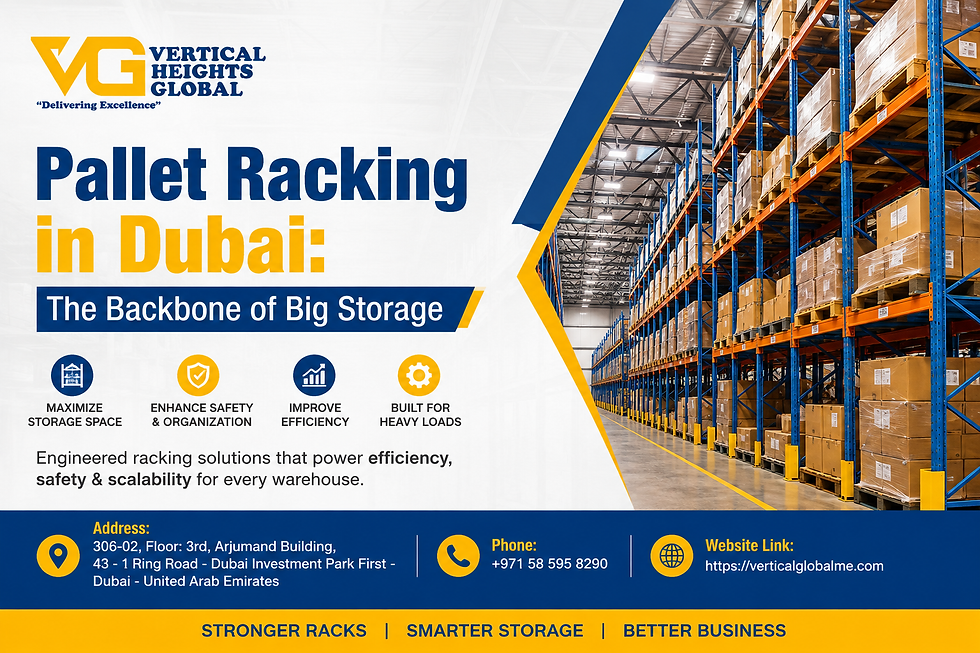
Dubai's warehouses are growing faster than the skyline above them. As e-commerce, logistics, and manufacturing activity expand across the emirate, the businesses running these facilities are under constant pressure to store more goods in less square footage. That pressure is exactly why pallet racking in Dubai has become one of the most searched-for storage solutions among warehouse owners, facility managers, and logistics operators across the UAE. Instead of spreading inventory across a wider footprint (which usually means paying for a bigger lease), companies are turning to vertical storage systems that let them build up rather than out.
This article walks through what this kind of racking system actually involves, why it matters for local businesses, the different systems available, and the questions people most commonly ask before investing in one. Whether you run a small distribution unit in Al Quoz or a large-scale fulfilment centre in Jebel Ali, understanding storage racking and how it fits into your layout will help you make a more informed decision.
Why Pallet Racking in Dubai Matters So Much Right Now
Warehouse rent in Dubai's key industrial zones has climbed steadily over the past few years, and floor space is treated as a precious, finite resource. When every square metre carries a cost, the smartest move is rarely to rent a bigger unit — it's to use the unit you already have more efficiently. This is where a well-planned racking system earns its reputation as the backbone of big storage. A well-designed racking system can turn a modest warehouse into a facility that stores two or three times more inventory, simply by making full use of vertical height instead of leaving it empty.
Beyond space efficiency, there's also the matter of organisation. A warehouse without structured storage racking tends to become chaotic: pallets stacked directly on top of one another, forklifts struggling to manoeuvre, and staff wasting time hunting for stock. Once a proper warehouse rack and shelf system is installed, every pallet gets an assigned location, inventory becomes easier to track, and picking times drop noticeably. For businesses running on tight delivery schedules — which describes most of Dubai's logistics sector — that kind of operational clarity has a direct impact on the bottom line.
Safety is another reason this topic comes up so often in search results. The UAE's climate, with its heat and humidity, along with the sheer volume of goods moving through Dubai's ports and free zones, makes structurally sound racking non-negotiable. Poorly installed or overloaded storage racking is a genuine hazard, and Civil Defence and municipality requirements exist precisely to prevent collapses that could injure staff or damage stock.
Understanding the Core Systems: Racking, Shelving, and Storage
Not every storage need looks the same, which is why the market offers several distinct approaches rather than a single one-size-fits-all product.
Pallet racking is designed specifically for palletised goods handled by forklifts. It typically consists of vertical upright frames and horizontal beams that create multiple levels, and it's the go-to choice for warehouses dealing with bulk quantities of packaged or boxed goods. Selective pallet racking, where every pallet is directly accessible without needing to move others, remains the most widely used configuration because it suits businesses with a large variety of stock-keeping units.
Warehouse rack and shelf systems, on the other hand, cover a broader category that includes both heavy-duty pallet frames and lighter shelving used for smaller, hand-picked items — think spare parts, retail stock, or archived documents. Many facilities in Dubai combine both: pallet racking for bulk storage in the main aisles, and shelving units for smaller items near the picking and packing stations.
Storage racking is often used as the umbrella term that ties these systems together. It can refer to drive-in racking (ideal for high-density storage of uniform goods), push-back racking (which uses gravity-assisted carts to store multiple pallets deep), cantilever racking (for long or irregularly shaped items like pipes and timber), and mezzanine racking (which effectively adds a second floor to a warehouse). Choosing the right type of storage racking depends heavily on the nature of your inventory, how often you need to access it, and how your forklifts move through the facility.
What Businesses Should Consider Before Installing Pallet Racking
Before committing to a system, most warehouse operators in Dubai weigh a handful of practical factors.
Load capacity is usually the first consideration when planning a racking installation. Standard selective racks typically support a moderate load per level, while heavy-duty industrial configurations are built to hold significantly more. It's common practice to calculate the weight of the heaviest pallet you'll store and add a safety margin on top, rather than designing a system that just barely meets your current needs.
Layout and aisle width come next. A racking system that looks efficient on paper can still slow down operations if the aisles are too narrow for your forklifts to turn comfortably. This is why a proper site survey and a CAD-based layout plan, showing exactly how many pallet positions the design will yield, is worth requesting before any purchase.
Material quality and climate resistance matter more in Dubai than in many other regions. The combination of heat and coastal humidity can accelerate corrosion in low-grade steel, so powder-coated or otherwise treated steel tends to hold up far better over the long term. Systems that meet recognised structural standards, such as EN 15512, generally offer more confidence than budget imports without documented load testing.
Scalability is the fourth factor, and it applies to any warehouse rack and shelf setup, not just large pallet installations. Businesses rarely stay the same size for long, and a racking system that can be extended, reconfigured, or added to later saves considerable cost compared to replacing an entire system when operations grow.
Local compliance and support round out the list. Working with a supplier that understands UAE regulations, including Civil Defence and municipality requirements, and that can provide load capacity labels for every bay, reduces both legal risk and downtime. Providers with a physical presence in the region, such as Vertical Heights Global in UAE, Dubai, are often better positioned to handle site surveys, after-sales support, and warranty claims quickly, compared with racking shipped in from overseas with no local backup.
What People Search Related to Pallet Racking in Dubai
Search behaviour around this topic tends to fall into a few clear patterns, and understanding them helps explain why this remains such a consistently active search term across Dubai's industrial community.
A large portion of searches are cost-driven. People search things like "storage racking cost per pallet position" or ask directly how much a full warehouse racking system will cost, because budgeting for expansion or a new facility fit-out is usually the starting point of the buying journey.
Another common pattern is local intent. Terms like "storage racking near me" or "pallet racking suppliers in Dubai" reflect a clear preference for working with companies that can visit the site in person, rather than ordering blind from an overseas catalogue.
Compliance and safety searches are also frequent, especially phrases related to UAE regulations, load capacity labelling, and structural certification. This reflects how seriously warehouse safety is treated across the logistics and industrial sectors in the region.
Comparison searches are common too — people looking into storage racking often compare pallet options against mezzanine flooring, or compare different racking types like selective versus drive-in, to figure out which system fits their specific mix of inventory and throughput.
Finally, there are maintenance and lifespan questions, since businesses want to understand how long a racking investment will realistically last before needing replacement or major repair, particularly given Dubai's climate conditions.
The Long-Term Value of Getting Racking Right
It's tempting to treat racking as a simple, one-time purchase, but the businesses that get the most value out of pallet racking in Dubai tend to treat it as an ongoing part of their operational strategy. That means scheduling regular inspections to catch bent frames or damaged beams before they become safety issues, training staff on correct loading procedures, and revisiting the layout periodically as product lines and order volumes shift.
A properly maintained system of storage racking doesn't just protect the investment itself — it protects everything sitting on it. Damaged goods, delayed shipments, and workplace injuries all carry costs that far exceed the price of routine maintenance. Combined with a well-planned warehouse rack and shelf setup, this kind of proactive approach turns racking from a background fixture into a genuine driver of efficiency.
Conclusion
As Dubai's warehousing and logistics sector continues to expand, the way businesses store their inventory has become just as important as the products themselves. Pallet racking in Dubai isn't simply a piece of industrial equipment — it's a structural decision that shapes how efficiently a warehouse runs, how safely staff can work, and how much a company can scale without the expense of a bigger building. From selective and drive-in configurations to broader warehouse rack and shelf setups, the right choice comes down to understanding your inventory, your throughput, and your long-term growth plans.
Businesses that take the time to plan their layout properly, choose materials suited to the local climate, and stay on top of regular maintenance tend to get decades of reliable use out of their storage racking system. And for companies that want that process handled by people who understand the region's specific conditions and regulations, working with an established regional provider, such as Vertical Heights Global in UAE, Dubai, can make the difference between a system that merely fits today's needs and one that's genuinely built to grow with the business.
Frequently Asked Questions
1. What is pallet racking used for in a warehouse?
Pallet racking is used to store palletised goods in an organised, multi-level system, allowing forklifts to place and retrieve pallets efficiently. It maximises vertical space so warehouses can hold significantly more stock without expanding their physical footprint.
2. What is the difference between pallet racking and shelving?
Pallet racking is built for heavy, palletised loads moved by forklifts, while shelving is generally designed for smaller items that are picked by hand. Many warehouses use a combination of both, with racking for bulk storage and shelving for smaller components near packing areas.
3. How much weight can pallet racking hold?
Weight capacity depends on the beam type, upright configuration, and overall design of the system. Standard selective racks generally handle moderate loads per level, while heavy-duty industrial racks are engineered to support considerably more, so it's important to always check the manufacturer's load rating for a specific setup.
4. How long does pallet racking last?
With proper installation, regular inspection, and routine maintenance, a quality racking system can last for decades. Powder-coated steel tends to perform particularly well against the humid, coastal climate found in Dubai.
5. What type of pallet racking is best for a warehouse with many different products?
Selective pallet racking is generally the best fit for warehouses handling a wide variety of stock-keeping units, since it gives direct access to every pallet without needing to move others out of the way first.
6. Is drive-in racking better than selective racking for high-volume storage?
Drive-in racking offers higher storage density and is well suited to large quantities of uniform products, but it sacrifices some selectivity since pallets are stored several deep. Selective racking offers easier access but uses floor space less densely, so the right choice depends on how varied your inventory is.
7. Do warehouse racking systems need to meet specific safety regulations?
Yes. Racking systems should comply with recognised structural standards and local safety requirements, including proper load capacity labelling, secure beam locking mechanisms, and periodic inspections, to reduce the risk of collapse or workplace injury.
8. What should I ask a supplier before buying a racking system?
It's worth asking for a detailed site survey, a CAD layout plan showing pallet positions and aisle widths, load capacity documentation for each bay, information on material certification, and details of ongoing warranty or after-sales support.


Comments